Dr Nazeer Khan

Author name: Nazeer Khan

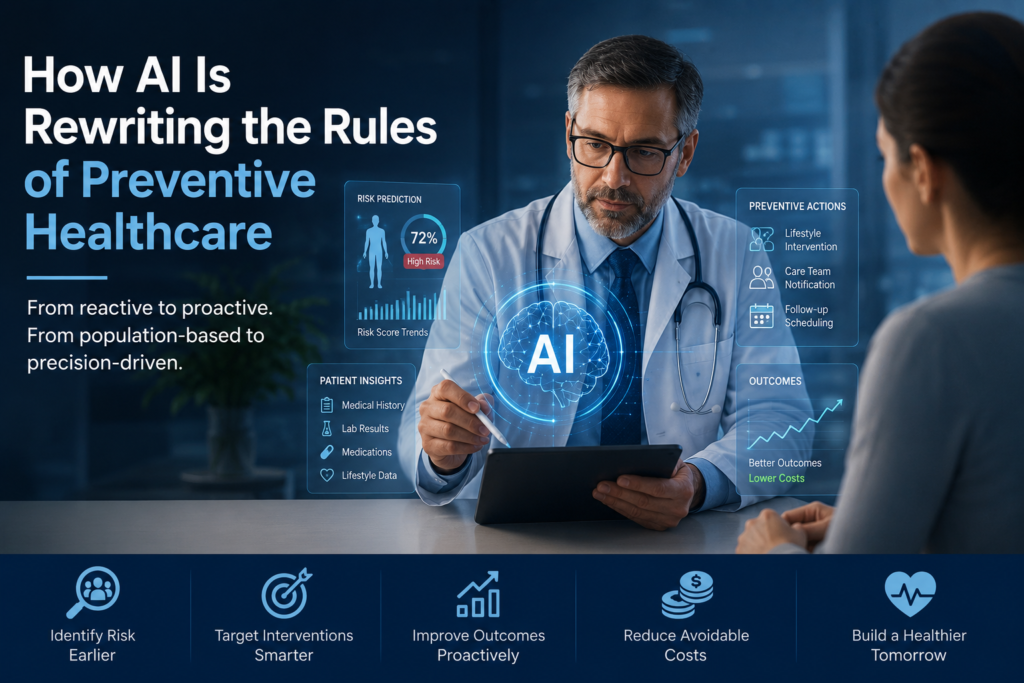
Doctor using artificial intelligence and predictive analytics to identify health risks and improve preventive healthcare outcomes
news

How AI Is Rewriting the Rules of Preventive Healthcare

Why Preventive Care Is Still an Afterthought Despite decades of discussion, preventive care remains marginalized. Health systems remain built around downstream treatment because it aligns with existing reimbursement structures and operational workflows. Clinicians are overloaded, and preventive protocols often fail to integrate into the real cadence of clinical practice. The result is predictable: late diagnosis, high avoidable costs, and preventive programs that fail to scale.The gap is not in clinical knowledge—we already understand how chronic disease develops. The gap is in our ability to consistently identify who is at risk early enough, with enough precision, and intervene without adding burden to clinical staff. AI changes this equation by providing the one ingredient prevention has always lacked: continuous, system-level intelligence. Core Insights 1. AI Pushes Risk Identification Upstream AI can detect patterns long before disease becomes clinically visible. Unlike traditional risk scores, which rely on static inputs, AI models incorporate real-time EHR(Electronic Health Record) data, demographics, claims information, and biosensor inputs.This allows risk prediction months or even years earlier. Operational implication: Earlier risk detection is only useful when paired with workflows that trigger action. AI provides systems the lead time they never had. 2. AI Makes Preventive Care Economically Defensible Most preventive programs collapse because they are too broad, too expensive, or do not produce measurable short-term ROI. AI solves these problems by identifying which patients will generate the highest cost savings if engaged preventively. A model deployed on 89,191 prediabetic patients demonstrated that targeted allocation of preventive interventions—driven by AI—could reduce system-wide costs by over $1.1 billion annually. 2 Operational implication: Prevention becomes financially viable when tied to predictive models that translate risk into avoidable costs. 3. Generative AI Is Rebuilding Preventive Pathways While predictive AI identifies risk, generative AI is beginning to redesign the workflow around prevention. It can simulate patient segments, compare intervention strategies, and recommend operational plans for care teams. A PwC analysis outlines how health organizations are using generative AI to model population health scenarios, predict resource needs, and coordinate interventions between clinicians, case managers, and administrative teams. 3 Operational implication: Generative AI is not “creative.” It is a planning engine that provides leaders a practical view of how preventive programs will actually run inside a real system. 4. Early Evidence Shows Tangible Outcome Gains Preventive AI tools are beginning to deliver measurable improvements in real clinical environments—not lab simulations. In the UK, Cera’s home-health platform uses AI to detect subtle deterioration patterns based on daily visit data. This shifted escalation from reactive to proactive and produced a 52% reduction in avoidable hospital admissions among elderly patients. 4 Similarly, the NHS is piloting an AI model capable of predicting type 2 diabetes risk up to 13 years before onset using standard ECG data. 5 Operational implication: Early trials show that preventive AI is not merely theoretically promising—it is clinically and financially relevant. 5. Preventive AI Creates a Sustainable ROI Loop Prevention has always been clinically sound but financially difficult. AI-enabled prevention closes this gap by tying predictions directly to cost avoidance. Machine-learning models for hospitalization risk, for example, have demonstrated potential reductions in hospitalization rates by 37–38%, generating meaningful savings for payers and providers. 6 Operational implication: When preventive care can demonstrate predictable ROI, it becomes easier to fund, scale, and integrate into reimbursement models, especially in value-based arrangements. Actionable Takeaways for Founders, Executives & Investors Conclusion AI is shifting preventive care from broad guidelines to precise, financially accountable, system-level action. The organizations that adopt AI-enabled prevention early will reduce avoidable costs, improve long-term positive outcomes, and establish a measurable competitive advantage in a value-driven healthcare environment.
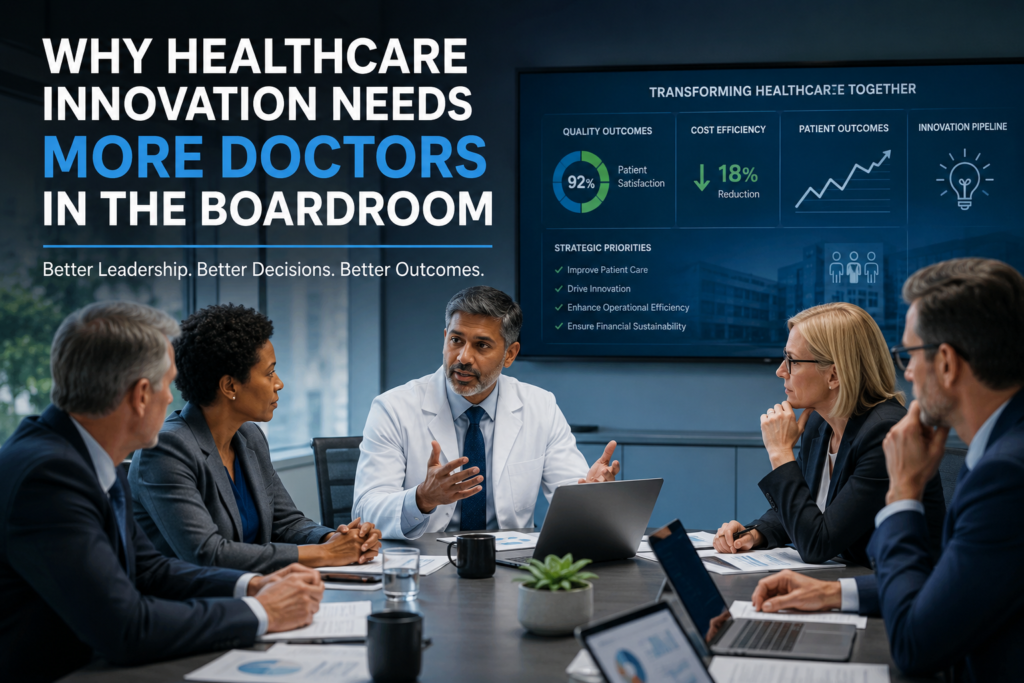

Physicians and healthcare executives discussing innovation and governance during a board meeting
news

Why Healthcare Innovation Needs More Doctors in the Boardroom

Healthcare innovation does not scale simply by adding technology; it needs leaders who understand both how things really work in the clinical realm and how the business side works. Innovative concepts require more doctors on board to align with care delivery, quality goals, and financial stability. What’s Broken and Why More Doctors at the Top Matters A lot of healthcare companies, like startups and health systems, still rely on boards made up of executives in business, finance, and law. These executives possess relevant skills but may not necessarily know how clinical workflow functions, how to keep patients safe, how all the pieces of healthcare delivery interact with one another, or the daily challenges faced by doctors. Such a situation would insinuate that the board is perhaps interested in financial gain, rather than the issue of ensuring quality care alignment among providers. This imbalance affects multiple stakeholders: patient care can suffer, clinician burnout persists, money is wasted due to inefficiencies in workflows, and innovative care models fail to scale because they lack governance buy-in from truly clinical leadership. To build systems that deliver value and innovation, boards need physician voices that understand both medicine and business. Core Insights 1. Boardrooms Are Overwhelmingly Non-Clinical Claim: There aren’t enough physicians on the boards of hospitals and health systems.Logic: When boards lack clinical expertise, they could make decisions that are more about making money rather than patient outcomes and system resiliency.Real-World Data: A study of 15 top US hospitals found only 14.6% of board members are healthcare professionals. Out of those, 13.3% are physicians, and just 0.9% are nurses. (1)This suggests that even in leading institutions, clinical insight is numerically marginalized. 2. Physicians on Boards Improve Quality Outcomes Claim: Clinical leadership at the board level correlates with improved patient-care indicators.Logic: When doctors set strategic priorities, they can better judge clinical risk, safety, and quality because they have firsthand experience.Real-World Data:  A survey of 370 German hospitals found that hospitals with physician CEOs had fewer pneumonia deaths and happier patients than hospitals with non-physician administrators.  (2)CEOs who have business training may benefit from money, but companies run by physicians who also understand the business side often obtain superior clinical results. 3. Underrepresentation Weakens Strategic Alignment to Quality  Claim: Boards largely composed of nonclinical directors may not prioritize lasting quality and safety initiatives.Logic: If there aren’t any clinical professionals on the board, short-term financial advantages may be more essential than things like turnover, readmissions, avoidable complications, and care coordination.Real-World Data: Research examining physician leadership in organizational settings highlights how clinical training shapes priorities around safety, quality, and long-term system performance. While literature does not directly quantify board-level effects, it consistently shows that when physicians participate in leadership and governance roles, clinical considerations are more likely to be integrated into strategic decision-making. (3)This misalignment undermines the board’s role in balancing cost and care priorities. 4. Doctors Bring Operational Insight That Improves Innovation Viability Claim: The Board of Directors, which includes physicians, offers critical perspectives on operational challenges.Logic: Startups and innovation teams don’t usually know about clinical workflow friction, EHR (Electronic Health Record) burden, and clinician adoption barriers. Physician board members can detect these hazards early on and assist in establishing the correct product market fit.Real-World Insight: According to a survey by AMN Healthcare, it indicated that just 11% of hospital CEOs are doctors and that boards include an average of 23% of physician members. AMN claims that this indicates that physician relations and value-based financial success are getting more in sync. (4)Having a physician on the board can help link governance and operations in ways that financial directors alone cannot. 5. Better Decision-Making Requires Clinical Legitimacy and Trust Claim: Having doctors on board increases credibility and execution at the frontline. Logic: Clinicians are more likely to support governance decisions when they see clinical judgment represented at the highest levels of oversight. Physician presence reduces the translation gap between strategy and care delivery, accelerating adoption while lowering resistance. Real-World Example: Multiple governance studies show that organizations with physicians in leadership roles perform better on quality and safety metrics. NEJM Catalyst reports that physician-led organizations demonstrate stronger alignment between clinical outcomes and operational priorities, while Harvard Business Review finds that hospitals managed by doctors consistently outperform peers on care quality and staff engagement.  (5)This alignment enables boards to balance quality, safety, and financial stewardship, an essential condition for scaling sustainable healthcare innovation. Actionable Takeaways for Founders, Investors & Healthcare Leaders Conclusion Innovation in healthcare doesn’t happen when only money is the sole factor. Boards consisting of doctors do a better job of meeting the needs of patients and the healthcare business.  Putting doctors in charge of the boardroom makes healthcare more strategic, provides better care, and fosters more long-term innovation.

news

Scaling Healthcare Ventures: From 1,000 to 1 Million Patients

What It Takes to Scale a Healthcare Venture from 1,000 to 1 Million Patients Healthcare ventures rarely fail for lack of demand. They fail because they try to scale complexity instead of scaling systems. Reaching a million patients is not a function of marketing spend or headcount; it’s a function of operating discipline and how efficiently a venture converts clinical capacity, technology, and trust into scalable outcomes. The Context: Why Healthcare Scaling Fails Most healthcare startups plateau between 1,000 and 10,000 patients. The barriers are not clinical competence or patient need; it is the operational bottlenecks. Fragmented data systems, clinician burnout, payer constraints, poorly trained administrative staff, and uneven patient acquisition funnels create a growth ceiling. Traditional responses, like hiring more doctors, hiring more administrative staff, adding new service lines, or expanding geographically, are usually ineffective. They increase cost without proportionate gains in throughput or patient retention. The result: declining margins and diluted quality. Scaling healthcare requires a fundamental redesign of process standardization, technology integration, economic alignment, investment in data driven command centers, along with patient acquisition and retention. 1. Build Scalable Clinical Operations, Not Heroic Ones In early-stage ventures, clinicians often carry the system. In scaled systems, the infrastructure supports the clinicians.  The key shift is from individual-driven care to protocol-driven care. A rapidly growing telehealth network demonstrates this principle; rather than hiring more clinicians, it scaled by standardizing common clinical scenarios into structured digital pathways. Routine consults followed consistent, efficient workflows, allowing physicians to focus on high-complexity cases while the system handled triage, documentation, and follow-ups. Standardization doesn’t lower the quality of care; it protects it and makes the operations run more smoothly. Many health systems have found that reducing unwarranted variations improves operational flow, shortens wait times, and increases reliability, often without adding staff. Scaling healthcare requires eliminating dependence on “star clinicians” and building a repeatable operating model that performs consistently across sites and shifts with any and all clinicians. 2. Integrate Technology as an Enabler, Not a Patch Healthcare technology often scales in silos: an EHR here, a patient app there, and a CRM for marketing. The result is data fragmentation.   A scalable venture integrates its stack around one longitudinal patient record—a unified data backbone that supports scheduling, triage, engagement, and reimbursement in one flow. Organizations that layer population-health analytics on top of their EHRs often report meaningful improvements in clinician efficiency, clearer visibility into high-risk patients, and fewer missed follow-ups due to automated reminders and streamlined task management. Scalability emerges not from adding tools but from reducing friction between them. Integration must start at the architecture level, not as a post-hoc IT project. 3. Align Economic Incentives Across Stakeholders Scaling healthcare ventures requires financial sustainability that supports both growth and quality.   In fee-for-service models, scaling means more visits; in value-based care, increasing means better outcomes and proactiveness per dollar. Many ventures fail to define which model they’re optimizing for. A home-health operator learned that payer alignment unlocks investment: by structuring a model tied partly to reducing avoidable issues rather than only billing per visit, it could reinvest in remote monitoring and AI-supported triage. This improved care coordination and optimized use of clinical teams. Early on in the scaling process, executives need to figure out the payer mix and how reimbursement works. Without economic alignment, every additional patient erodes, rather than strengthens, the business model. 4. Invest in a Data-Driven Command Center Scaling healthcare is an exercise in managing variance at scale: clinical, operational, and financial. A central “command center” model helps maintain visibility across distributed networks. A large primary-care network used this approach by creating a single operational dashboard to monitor daily volumes, clinician workload, and quality indicators. With shared visibility, performance variability across sites reduced substantially, and coordination improved across the entire system. Such command centers are not dashboards for reporting; they are real-time operating systems. They convert lagging indicators into leading ones, allowing faster interventions and systemic accountability. 5. Redesign the Patient Acquisition and Retention Funnel Most healthcare ventures treat acquisition as a marketing function. Scaled systems treat it as a clinical and operational function. To get from 1,000 to 1 million patients, the flow of patients needs to be predictable, and there can’t be much leakage. Multispecialty groups that use EHR data to identify care gaps often see stronger long-term retention. By proactively reaching out, ensuring timely follow-ups, and automating chronic-care pathways, they build deeper trust and improve lifetime value. The real scale multiplier is retention. In healthcare, every patient who stays with you is a sign of trust, not merely a source of income. Actionable Takeaways for Founders and Executives Conclusion Scaling a healthcare endeavor from 1,000 to 1 million patients is not a linear journey—it’s a systems revolution. It’s not the firms that grow the fastest that do well; it’s the ones that standardize better, integrate more deeply, and align incentives sooner. In healthcare, genuine scale happens when the system, not the individuals, becomes the multiplier.

news

From Clinician to CEO: A Physician’s Leadership Roadmap

From Clinician to CEO: A Physician’s Roadmap to Executive Leadership Healthcare needs leaders who understand both patients and balance sheets. Yet most physicians trained to diagnose disease are not trained to lead organizations. Transitioning from clinician to CEO requires unlearning the instinct to manage individuals and learning to govern systems. The shift is not from medicine to management; it’s from clinical reasoning to organizational reasoning. The Context: Why Healthcare Needs Physician-Executives and Why Few Succeed The gap between clinical operations and executive decision-making remains one of healthcare’s most persistent inefficiencies. Boards often lament the absence of physician leaders who can translate care realities into business strategy. At the same time, physicians entering leadership roles frequently struggle with governance, capital allocation, and people management; such disciplines are never taught in medical school. A 2023 NEJM Catalyst survey found that while 65% of healthcare organizations prefer physicians in executive roles, fewer than 20% of physician leaders report having formal business or leadership training. Most fail not for lack of intelligence, but for lack of transition discipline. They continue to operate like chief clinicians instead of system stewards. 1 The path from clinician to CEO is not a career switch; it’s a capability transformation. 1. Redefine Your Core Skill: From Clinical Judgment to Strategic Judgment Clinicians make decisions with limited data under time pressure. Executives do the same, but with broader consequences and longer timelines. The key shift is moving from diagnosing problems to designing systems that prevent them. In high-performing delivery systems, physician-executives have applied clinical diagnostic frameworks to operational issues: mapping “presenting symptoms” of delay or inefficiency and conducting root-cause analysis. McKinsey commentary on system operations suggests that applying clinician-style diagnostic rigor to workflows can reduce rework and duplication, but real scaling requires financial tools like capital planning and risk modeling. This combination improves both clinical clarity and financial prioritization. Strategic judgment in healthcare leadership involves synthesizing policy, payer mix, and population health data to guide direction, not just to solve discrete operational issues. 2. Learn the Economics of Care Delivery A physician CEO cannot rely on intuition for financial decisions. Understanding reimbursement models, payer dynamics, and cost-to-serve metrics is non-negotiable.  Most clinicians underestimate how economics shape clinical operations from length of stay targets to formulary restrictions. Take the example of multispecialty networks participating in the Medicare Shared Savings Program (MSSP). Physician leadership teams who developed fluency in how CMS quality metrics influence reconciliation and benchmark-setting saw stronger financial results. For example, Privia Health reported $176.6 million in shared savings in 2023, with a 7.6% aggregate savings rate. 2 The physician-to-executive transition requires learning to read financial statements with the same fluency as lab results. EBITDA margins, payer mix ratios, and utilization metrics become as critical as lab values and vitals in running an efficient and profitable clinical organization. 3. Shift from Managing Cases to Managing Culture In clinical practice, accountability is individual. In leadership, it’s systemic. Culture determines how consistently the mission survives across teams, sites, and crises.  Physicians entering leadership roles often underestimate how much of their success will depend on building governance, not charisma. In high-reliability healthcare systems like Virginia Mason, frontline leaders hold weekly cross-functional huddles with unit managers, physician offices, and nursing to talk about operational and quality issues, make decisions, and give advice. 3  These huddles institutionalize leadership presence and drive consistent performance across departments, helping reduce variation and reinforce accountability practices strongly associated with improved process reliability, team engagement, and organizational performance. 4  For a physician CEO, culture management means creating predictability and converting personal leadership habits into organizational operating norms. 4. Build a Scalable Decision Infrastructure Clinical teams rely on EHRs, guidelines, and checklists to maintain consistency. Executive teams need the same. Scaling leadership effectiveness requires establishing decision infrastructure: dashboards, accountability matrices, and governance rhythms. A scalable healthcare organization depends on operational transparency, not just leadership intent. Command centers, rolling forecasts, and shared metrics make execution less dependent on individual brilliance and more on institutional muscle memory. Clinicians who become CEOs do best when they manage the organization like they manage a patient: by using data and dashboards to make decisions instead of relying on gut feelings. Applying “evidence based” clinical decision making to executive and operational decision making. 5. Translate Clinical Empathy into Organizational Credibility Clinicians are trusted because they listen before acting. The same principle applies to executive leadership but with broader stakeholders. Boards, investors, payers, and regulators all require a leader who can empathize with their pressures while maintaining alignment to the mission. Physician-led networks that effectively blend medical expertise with business knowledge often experience noticeable growth in contracts. For example, Privia Health’s 2024 MSSP results highlight its physician-driven model and data infrastructure as central to its shared-savings performance. 5 Healthcare leadership today demands bilingual fluency: the language of clinical medicine and the language of healthcare administration. Actionable Takeaways for Aspiring Physician-Executives Conclusion The transition from clinician to CEO is not about leaving medicine; it’s about scaling its principles. The physician who integrates clinical logic, operational discipline, and economic reasoning becomes more than an administrator; they become an enterprise strategist capable of steering complex health systems.

Scroll to Top